
Sung to the tune of “Twinkle, Twinkle, Little Star”:
Racist racist Noah Carl
How I’m shocked that here you are
In St. Edmund’s you seem so high
Like a racist in disguise
This piece of unrhymed doggerel, along with a petition signed by hundreds of academics, persuaded the administration at St. Edmund’s College, Cambridge to fire Noah Carl in 2019. One of Carl’s supposed crimes was writing an article in Evolutionary Psychological Science titled “How Stifling Debate around Race, Genes and IQ Can Do Harm.” He also reported politically incorrect data on crime and immigration.
In May 2022, I received an offer for a three-year Leverhulme Early Career Fellowship in the Faculty of Philosophy at Cambridge. Most of my friends warned me not to accept. What happens if people rewrite the lyrics of “Twinkle, Twinkle, Little Star” to be about how I am a racist? The fact that “Cofnas” doesn’t rhyme with anything won’t stop the protesters. Then I will be fired and my career will be over. Better to take another attractive offer I got from a top university in Asia where the students don’t care about Western political correctness.
I made the fateful decision to go to Cambridge because of what happened after the Noah Carl affair. In December 2020, the university instituted iron-clad protections for free speech. The University Statement on Freedom of Speech, which was approved by the university’s governing body with 87% of the vote, made the following declaration:
The University will ensure that staff are able to exercise freedom of thought and expression within the law without placing themselves at risk of losing their job or any University privileges and benefits they have.
In case this was unclear, the Statement emphasized that protection extends to views that are considered “disagreeable, unwelcome or distasteful” (as all unorthodox views, right or wrong, are perceived by the majority). There was no escape clause or wiggle room. After 811 years, Cambridge was now a free speech university.
It was a lie.
After accepting a job at Cambridge on the promise of free speech, I was betrayed the moment the administration determined that free speech was inconvenient for them. I was effectively driven off campus with threats of violence against me brushed off as not a big deal. I was forced to resign from my paid position as undergraduate examiner. A senior administrator and two philosophy professors (including the chair of the faculty) met with student protesters to conspire about how to “[get] rid of him” even before they had bothered filing trumped-up charges against me. The Faculty of Philosophy adopted new policies to ensure that controversial scholars could never be hired again. I was subjected to a year-and-a-half-long investigation straight out of Idiocracy. Emmanuel College, where I held the position of College Research Associate, terminated me on the grounds that my belief in hereditarianism “amounted to, or could reasonably be construed as amounting to, a rejection of Diversity, Equality and Inclusion (DEI and EDI) policies.”
In December 2025, Cambridge published a “Statement on Disciplinary Investigation (Dr Cofnas)” on the university’s website. Leaving aside some anti-racist boilerplate, it is just two sentences long:
Dr Nathan Cofnas published a blog which provoked considerable controversy and prompted a significant number of complaints which the University, as his employer, was duty bound to investigate. A rigorous inquiry concluded that [Cofnas’s] published views, while seen by many as offensive, did not breach the law and did not contravene University regulations designed to uphold free speech.
According to Cambridge, that’s the whole story. Complaints were investigated and then I was exonerated.
Here I will tell the true story of what happened. I’ll only leave out some minor details to protect innocent parties and avoid talking about conversations that were off the record.
The most obvious lesson is that Cambridge is not a free speech university, and anyone with controversial views would be a fool to accept a job there. There are also broader lessons about the state of free speech in academia in general, and philosophy in particular.
“He Must Not Be Welcome”
Soon after I arrived at Cambridge in September 2022, the student newspaper Varsity ran the first of what would be literally dozens of exposés and smear pieces that it would publish about me. According to the article:
In 2019 [when he was a DPhil student at Oxford] Nathan Cofnas became embroiled in controversy over an article he wrote, in which he argued that genetic differences in IQ could exist between racial and ethnic groups. In the article Cofnas also said that since “truth is intrinsically valuable”, it is scientists’ duty to uncover it even when controversial....The article sparked academic backlash, with a group of scholars rejecting his claims as pseudoscience in a published response.
A couple years later, Varsity would list this bombshell as one of three “historical and discourse-shaping stories” that the paper had broken in its history. The other two stories were the 1953 discovery of the structure of DNA by James Watson and Francis Crick and the university’s proposed £400,000,000 deal with the United Arab Emirates in 2021. But going back to September 2022...
That evening, Daily Mail journalist Elizabeth Haigh emailed me to say she was working on an article based on the Varsity piece. She wrote:
I was also wondering if you have anything to say now about your claims in that article that it is wrong to assume that all “human groups have, on average, the same potential”, and especially your referral to “early interventions” including the forced adoption of black children into white families.
I called her on the phone, and she spent most of our eight-minute conversation arguing that I advocated for the “forced adoption of black children into white families,” insisting that my paper was somehow “unclear” on the point. (In fact, the paper had been widely read and no one else had ever made this bizarre claim.) She finally relented and agreed to at least remove the word “forced.”
A few minutes later the article appeared on the Daily Mail’s website with the headline:
EXCLUSIVE: Controversial ‘race researcher’ who wrote a 2019 report about so-called ‘gaps’ in IQ between white and non-white people is hired by Cambridge University’s philosophy faculty—and says the university knew about it before hiring him
This is what set off the first round of student protests.
A group of students studying for a Master of Studies degree in “AI Ethics & Society” at the Leverhulme Centre for the Future of Intelligence at Cambridge signed a petition to express their “concern” regarding my appointment. According to the petition, I am a “self-described scholar focused on ‘scientific and ethical controversies connected with evolution-informed social science’” and a “proponent of scientific racism.” They expounded: “As we discussed in the first module of our MSt in AI Ethics & Society, designations of intellectual inferiority have historically been used to advance necropolitical oppression on vulnerable populations.” (I am still not sure what “necropolitical oppression” is.)
The director of the Centre, Stephen Cave, is best known for co-authoring a paper arguing that robots are racist because they are often made from white plastic. So you can probably guess which side he took in this controversy. From his perspective, talking about race differences in IQ is 20 times more racist than white robots. Professor Cave emailed students promising to “raise their concerns with the Head of School, Chair of the Philosophy Faculty, and Director of the Leverhulme Trust.” He held a meeting at the Centre to complain about me, with no one being allowed to speak in my defense.
Another petition signed by dozens of students at the Sanger Institute for genomics research stated that I am a “self-proclaimed ‘philosopher of biology and ethics’” who “must not be welcome in the Cambridge academic community.”
A third one titled “Petition to Terminate Employment of Controversial Fellow Nathan Cofnas at the University of Cambridge,” which was open to the public, was signed by more than 1,200 people. It referred to my “extremely incendiary and casually racist publication stating that there are ‘gaps’ in IQ between different racial groups.” (The fact that there are measured racial gaps in IQ is not disputed by informed commentators, including those on the anti-hereditarian side.)
Cambridge University is very concerned about microaggressions such as “raising eyebrows when a black member of staff or student is speaking.” Nevertheless, the administration apparently had no problem with students distributing a letter declaring that someone they disagree with is a “self-described scholar” who “must not be welcome in the Cambridge academic community.” And they were fine with Professor Cave using university resources to wage a smear campaign against his colleague.
Although they may not have been happy to have me around, the administration decided that it wasn’t worth going through the rigmarole of trying to fire me. At least not yet.
Hereditarian Revolution
In January 2024, I published the first essay on Nathan Cofnas’s Newsletter, “Why We Need to Talk about the Right’s Stupidity Problem.” I reviewed several lines of evidence that cognitive elites lean left and woke, and that the dysfunction of the right stems from its human capital problem. No one at Cambridge had any objection to me saying that right wingers have a lower average IQ for genetic reasons.
In February 2024, I published “A Guide for the Hereditarian Revolution.” It included a frank discussion of race differences, and what the consequences would be if we got rid of affirmative action. For example, I cited an internal study conducted by Harvard in 2013, which found that, if admissions were based only on grades and test scores, its undergraduate population would be approximately 0.7% black, down from the current ~14%. (Many people are incapable of understanding that this statistic comes from Harvard and is not something that I just made up.)
Under a colorblind system, the most high-profile elites in many domains would be drawn largely from the IQ >135 range. The current level of black representation in these positions is maintained by Harvard-style affirmative action. In a colorblind system, blacks and whites would be subject to the same IQ cutoffs, and demographics in elite spaces outside of sports and entertainment would change dramatically. This would have potentially unacceptable social consequences. In the Guide, I wrote that “it may be necessary to guarantee some minimal representation in certain leadership positions to major demographic groups....[W]hen it comes to policy making in a multiracial society, we might need to make sure that everyone feels they have a voice in determining our collective fate.”
The response was hysterical.
My old friend Elizabeth Haigh at the Daily Mail published an article attributing two fake quotes to me in the headline. Using quotation marks, she said I claimed that, in a meritocracy, “black people would only be famous for sports and entertainment” and that Harvard would “have no black professors.” Both statements are false and not something I ever said. The Daily Mail refused to correct this, or even remove the quotation marks around the fake quotes.
Supposedly anti-woke LBC radio presenter Nick Ferrari conducted an interview with me where he enlarged my face to take up the entire screen, turned off my mic, and bellowed: “I have heard from a young female black student who has expressed her distress because of this!”
Both the university and my college decided it was time to squash this outbreak of free speech.
The University: Mob Rule
On February 16, 2024, Pro-Vice-Chancellor for Education Bhaskar Vira issued a statement on behalf of the university affirming my right to free speech. He wrote:
Freedom of speech within the law is a right that sits at the heart of the University of Cambridge. We encourage our community to challenge ideas they disagree with and engage in rigorous debate. While we encourage freedom of speech, it is important to be clear that the voice of one academic does not reflect the views of the whole University community.
However, the administration quickly determined that the protesters weren’t going away and that it would be easier to give in to the mob.
On February 23, interim Chair of the Faculty of Philosophy Angela Breitenbach, the aforementioned Vira, and philosophy professor Sophia Dandelet (now at UW-Madison) held a meeting with around two dozen student protesters where they formulated a plan to fire me. According to the minutes of the meeting written by a student, Dandelet stated, apparently without anyone present objecting:
there needs to be an official body to look at the code, the behaviour, and develop the explicit rationale to getting rid of him.
Vira, who had previously affirmed my right to free speech in the university’s statement on February 16, was recorded saying:
Cofnas has crossed the line of all the concerns for ‘freedom of speech’.
None of these statements were based on new information. Apparently, university administrators decided to reverse their position on my academic freedom simply because of pressure from students.
Breitenbach also told the students that the Faculty of Philosophy was changing its hiring procedures so that no one like me would ever be hired again. Previously, decisions were made by a committee. From now on, finalists’ dossiers will be distributed to everyone in the faculty to be examined for any sign of controversial views.
Around this time, I was put under tremendous pressure to resign from my job as undergraduate examiner. I was told:
I didn’t think that you would fail to be impartial in your marking. But if students think that it is even a possibility, then that threatens the reliability of the process.
Although I was not asked to do so, I voluntarily withdrew from all contact with students. I won’t get into the details of the reasoning behind that decision. However, the fact that I felt a need to take this action reflects the fact that free speech was not being protected. The same point applies a fortiori to being forced to resign as examiner because students disagreed with my views.
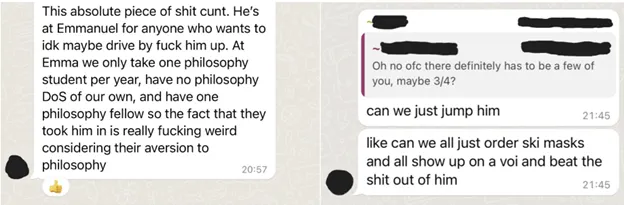
On February 20, I was alerted to the fact that some philosophy students had issued calls for violence against me in a WhatsApp group chat with 59 members. One of the people posting threats was a student at Emmanuel College, where I was a College Research Associate. I reported this to Breitenbach, who took no action, claiming that the threats were “not credible.” I then reported it to the university. After an investigation that dragged on for over four months, the students were found to have breached the “Rules of Behaviour for Registered Students” because, according to the university’s report, “The wording suggests to recipients that they carry out violent acts against Dr Cofnas.” The students were asked to “write up a reflection of what they could do differently in [the] future in such situations and reflecting on the impact of their words on other people.”
Philosophical debate at Cambridge
Emmanuel College: Cofnas Is a Gay Nazi, LOL
Cambridge is a collegiate university with 31 semi-autonomous colleges. All students and most faculty members are affiliated with both a department and a college. In addition to my paid fellowship in the Faculty of Philosophy, I also held an unpaid position as College Research Associate at Emmanuel College. (Fun fact: Emmanuel was the alma mater of John Harvard and the model for his namesake university in Cambridge, MA.)
The Master of Emmanuel is retired Lieutenant General Doug Chalmers. If anyone could be counted on to follow the university regulations on free speech, it would presumably be a military man. A man who is not afraid of war surely would not be afraid of students.
At first, Chalmers took a strong stand for free speech. On February 9, 2024, he sent an email to the college mailing list in which he “acknowledge[d] Dr Cofnas’s academic right, as enshrined by law, to write about his views.”
However, just two days later, he was pouring gasoline on the fire. On February 11, Chalmers and the Senior Tutor Corinna Russell sent an email to everyone on the college mailing list. Referring to “A Guide for the Hereditarian Revolution,” they said that “Nobody is free to do their best work whilst false narratives of this kind continue to call into question a scholar’s right to be part of this community.”
On February 16, a writer for Emmanuel College’s satirical student newspaper ROAR sent a draft of an article he wrote to Chalmers and Russell. The student said he wanted to “check with you both directly on whether you have any issues with this draft. I don’t want anything that would offend college to be published on Sunday, so I’m more than happy to remove anything that you flag up.” The fact that satirists seek permission from authority figures before publishing articles is its own scandal, but leave that aside.
The article asserted that I was “setting up ‘Emma Skinhead Society,’” “graduating from Victorian-era racism to 1960s racism,” and was the “lover” and “life partner” of a male student at the college. Chalmers replied that “you have done a superb job in satirising this” and “We are very lucky to have people like you in our community.” Dr. Russell replied: “I’m not sure what we’ve done to deserve you. Wisdom and self knowledge from the editors; a fitting response to the ‘ideas’ this person has put in the public domain; a Roar column that gave me a proper laugh.”
On March 8, Chalmers told me that he was “considering” terminating my position as College Research Associate because of the “hurt” he said I had caused. I asked what happened to the commitment to free speech, and he did not have much of an answer other than to repeat that my exercise of academic freedom had caused “hurt.”
Against the Mob
On April 12, 2024, one of the most respected philosophers in the world, Peter Singer, published an article titled “Will Cambridge Support Free Speech?” He wrote:
The academic world will be watching what happens. Were the University of Cambridge to dismiss Cofnas, it would sound a warning to students and academics everywhere: when it comes to controversial topics, even the world’s most renowned universities can no longer be relied upon to stand by their commitment to defend freedom of thought and discussion.
Fourteen free speech supporters published a letter in the Times of London asking the university and college to “call off their investigations. There is nothing to investigate.” It was signed by Roger Crisp, Sir Partha Dasgupta, Marie Daouda, Paul Elbourne, Jonathan Glover, Coleman Hughes, Matthew Kramer, Brian Leiter, Jeff McMahan, Francesca Minerva, Steven Pinker, Robert Plomin, Peter Singer, and Amia Srinivasan.
William Mackesy and Andrew Neish—lawyers who represent the Alumni for Free Speech organization—sent letters to both the university and the college warning that “there is a strong possibility that Mr Cofnas’ views would be deemed protected if this came to a Tribunal hearing. So, your University may already be acting unlawfully.”
Matthew Kramer—a legal philosopher at Cambridge—wrote a separate letter where he claimed that my “pronouncements [are] glib and abhorrent” and “objectionable blather,” but that they are “fully protected by the moral principle of freedom of expression.” While it was nice to have a professor at Cambridge publicly support free speech, the letter was annoying. First, I wasn’t at liberty to respond to Kramer’s attack because I couldn’t speak openly during an ongoing investigation. Second, his opinion about my work was irrelevant to the issue at hand (academic freedom). Third, Kramer has no background in race or psychometrics, and no qualifications to evaluate my essay. But he felt that he couldn’t defend my academic freedom without explicitly distancing himself from my views. Most people at Cambridge who supported me did not do so publicly, since they (justifiably) feared that the administration might retaliate against them.
In any case, students’ tears trump arguments for free speech. The university and Emmanuel College proceeded with their plans.
Justice, Cambridge Style
In June 2020, Cambridge Professor of Postcolonial Studies Priyamvada Gopal tweeted her view that “white lives don’t matter.” After backlash, the university released a statement saying: “The University defends the right of its academics to express their own lawful opinions which others might find controversial.” This implies that, even before the Statement on Freedom of Speech came into effect in December of that year, the administration’s official position was that academics are free to express controversial opinions as long as they are lawful.
In February 2024, under the direction of Angela Breitenbach, the university hired an outside lawyer named Aileen McColgan to determine if statements I made in “A Guide for the Hereditarian Revolution” were legally protected. Being legally protected is very different from being lawful. When Gopal said that “white lives don’t matter,” the standard was speech is allowed as long as it’s not criminal. But when people got mad at me for citing Harvard’s admissions study, the standard changed to speech is allowed as long as there is a law specifically prohibiting us from punishing it.
McColgan is a feminist who believes strongly that racial disparities are caused by white racism. She interrogated me for three hours, mocking and sneering at me. She laughed out loud at my suggestion that some white children could feel shame for being white, and argued that I did not have scholarly competence to comment on race. Unsurprisingly, she wrote a report saying that my essay was not legally protected, largely because, according to her, it did not display academic competence.
She explained her reasoning as follows:
NC defended the statement...on the basis that less than 2% of Americans with an IQ of 120 (which he suggested indicated an ability to perform cognitively complex jobs) were Black (by which again I understand African American), as were approximately 0.76% of Americans with an IQ of 135. He made several references to Google engineers. Assuming that these statistics are correct, I do not accept that they provide a sufficient underpinning for the assertion that ‘Blacks would disappear from almost all high-profile positions outside of sports and entertainment...’. Even assuming (which I do not accept) that only those with IQs of 135 and above are ‘high profile’ outside sports and entertainment, Black Americans account for about 12.1% of about 333.3 million Americans. 0.76% of Black Americans amounts to over 3 million Black Americans with an IQ of over 135. This being the case, the statement that in a meritocratic system ‘Blacks would disappear from almost all high-profile positions outside of sports and entertainment’ appears to be without foundation.
This is wrong, and her estimate is off by more than two orders of magnitude. Less than 2% of Americans with an IQ of at least 120 (not equal to 120) are black, and 0.76% of Americans with an IQ of at least 135 are black. McColgan multiplies the black population by 0.076 and concludes that there are “over 3,000,000 Black Americans with an IQ of over 135.” This appears to be an inept attempt to calculate 0.76% of the black American population (to obtain which we would multiply by 0.0076, not 0.076). But the fact that 0.76% of Americans with an IQ of at least 135 are black does not mean that 0.76% of African Americans have an IQ of at least 135. An IQ of at least 135 is at least 3.33 standard deviations above the African American mean. 0.04% of black Americans have IQs in this range, which is approximately 16,000 African Americans, not “over 3 million.”
There is a pattern of McColgan finding things offensive due to her misunderstanding of statistics. In one of her tweets (below) she expresses offense at the fact that there was a four-person panel with “only” one woman. If we assume that men and women are selected randomly for a panel (so there is no sex discrimination), the probability that there will be 0–1 woman on a four-person panel is 31.25%. If we include the male chair as a panelist and call it a five-person panel, the probability of having “only” 0–1 woman by chance is 18.75%—still not remotely close to being statistically significant. Yet McColgan finds this result offensive enough to make a public statement insinuating that some people are guilty of sexism.

Math expert Aileen McColgan hired by Cambridge University to argue with me about social science
McColgan wrote:
None of these observations in my view provided sufficient justification for NC’s suggestion that, in a colour-blind system, African Americans (in his language, ‘blacks’) would comprise even less than 0.7% of Harvard students. In the first place, the 0.7% (in fact 0.67%) figure was based on statistics which pre-dated 2013, and so the relevance of current teaching practice is unclear. Secondly, NC did not suggest that his references to DEI culture were grounded in academic research (his or anyone else’s).
McColgan appears to think that she is challenging my claim that Harvard students would be <0.7% black by pointing out that the original statistic was “in fact 0.67%.” It is possible that she thinks that 0.67% is larger than 0.7%, which, of course, is wrong. The claim that I “did not suggest that [my] references to DEI culture were grounded in academic research” was also wrong. In the essay I referenced work by, for example, Richard Hanania and Heather Mac Donald.
McColgan took special exception to my description of Thomas Sowell’s theory of race differences. (Sowell is an economist at the Hoover Institution at Stanford University and arguably the most important black conservative intellectual in American history.) In an influential book, Black Rednecks and White Liberals, Sowell expresses his view that African Americans adopted a suite of cultural values from poor white Southerners that, in his words, includes
an aversion to work, proneness to violence, neglect of education, sexual promiscuity, improvidence, drunkenness, lack of entrepreneurship, reckless searches for excitement, lively music and dance, and a style of religious oratory marked by strident rhetoric, unbridled emotions, and flamboyant imagery.
Needless to say, it is impossible to accurately describe Sowell’s theory in a way that wouldn’t be offensive to an angry woke feminist leading a racism investigation. McColgan determined that my description of Sowell’s ideas involved “crude and casual stereotyping whose effect, if not its purpose, is to denigrate Black people.”
McColgan slammed me for writing “statements which suggested” that, in the context of a discussion of affirmative action in America, in a “fair system they [Blacks] would be less likely than Whites to be in an elite academic institution.” But the fact that, without affirmative action, blacks would be less likely than whites to be at elite academic institutions is literally the reason why we have affirmative action in the first place. At Cambridge, mentioning this uncontroversial fact is grounds for losing the protection of academic freedom.
I presented McColgan with letters from two eminent social scientists—Garett Jones and Richard Haier—testifying to my academic competence in relation to “A Guide for the Hereditarian Revolution.” Jones published an influential book on cross-national differences in IQ and their relevance for economics with Stanford University Press. Haier was the longtime editor-in-chief of Intelligence, which was the flagship journal in the field of intelligence research, and author of The Neuroscience of Intelligence, which is an important interdisciplinary textbook published by Cambridge University Press.
McColgan summarily dismissed Jones and Haier as not having relevant expertise! She wrote:
Professor Jones is an economist whose qualifications to opine on the academic merits of NC’s work are unclear to me....Professor Haier is not, as far as I understand, a social scientist with a track record in the study of education, family demographics, criminology and/or gender ideology.
Having decided that Jones and Haier have no business commenting on intelligence research, McColgan relied on her own self-perceived expertise, which led her to conclusions such as “over 3 million Black Americans [have] an IQ of over 135” and 0.67 is bigger than 0.7.
I sent Angela Breitenbach a response I wrote to McColgan’s report, which pointed out these and other errors that are too numerous to recount here. Breitenbach replied that—surprise—McColgan “has confirmed that [your response does] not fundamentally alter her conclusions,” and “Any remaining concerns you have about the contents of the investigation report can be raised as appropriate if the matter proceeds to a Disciplinary Committee.” Breitenbach appointed an independent HR specialist to decide what to do in the light of the fact that my speech was allegedly not legally protected.
Before interrogating me, the HR specialist interviewed seven students who had filed formal complaints against me. Of these seven students, only one claimed to have read the University Statement on Freedom of Speech. More than a year into a major free speech crisis, apparently no one asked the student protesters to acquaint themselves with the university’s free speech policy.
On August 12, 2025—20 days before my contract was set to expire—I was informed that the university was closing its investigation. The conclusion was that I did not violate university policy because my speech was “lawful”—something that everyone knew on day 1. The investigation appears to have been an extrajudicial means of sequestering me for a year-and-a-half until I would leave upon the conclusion of my fellowship.
Emmanuel’s Kangaroo Court
On March 25, 2024, Emmanuel College’s Fellowship Committee, chaired by college Life Fellow Mike Gross, convened to make a decision about my case.
I suspect that Dr. Gross has strong personal feelings about the subject of intelligence testing and meritocracy. According to his online bio, he failed the 11-plus exam and applied to Emmanuel College because it was “the first Cambridge college to abandon admissions examinations.” He wrote his PhD dissertation in economics on the idea that “employment opportunities are restricted on the basis of gender, race and various socio-economic characteristics.”
On April 5, 2024, I received an email from Gross. He explained as follows:
The Committee first considered the meaning of the blog and concluded that it amounted to, or could reasonably be construed as amounting to, a rejection of Diversity, Equality and Inclusion (DEI and EDI) policies. It could not be read simply as an academic critique or discussion of how EDI values should be interpreted....The Committee concluded that the core mission of the College was to achieve educational excellence and that diversity and inclusion were inseparable from that. The ideas promoted by the blog therefore represented a challenge to the College’s core values and mission. Actively promoting and defending the College’s values was critical in forwarding and fully achieving the College’s educational purposes.
Cambridge University was founded in 1209; Emmanuel College, in 1584. DEI ideology in its current form dates back to around 2012. Cambridge University’s policy on “Equality & Diversity” was published online in 2014, and its name wasn’t changed to “Equality, Diversity & Inclusion” until late 2022. But expressing a “challenge” to DEI policies that were formulated 12 years ago now disqualifies someone from being a scholar at Cambridge, according to Emmanuel College.
With assistance from Bryn Harris—the Chief Legal Counsel at the Free Speech Union—I appealed the decision on the grounds that “no reasonable body could have reached the decision to terminate [my] position as a CRA.” The secretary of the Appeals Committee was Mike Gross again—the same person who chaired the first committee. There was barely a façade of impartiality.
Still not willing to leave anything to chance, the Master Doug Chalmers and Senior Tutor Corinna Russell sent a letter to the Appeals Committee asking for a specific outcome. Their letter concluded: “The Fellowship Committee’s findings in this regard should be upheld.”
Needless to say, the Appeals Committee determined that nothing was unreasonable. My position as College Research Associate was officially terminated.
Actual Court
With the help of the Free Speech Union, I filed a lawsuit against Emmanuel College for belief discrimination under the Equality Act 2010.
Chalmers et al. realized that it was a bad look to say that I was kicked out for questioning DEI. They now insist that I had to be punished because I violated the college’s “Culture of Respect” policy.
There were three primary issues to be decided during the trial, which took place at the end of January 2026:
(1) Is hereditarianism a “protected philosophical belief” under UK law?
(2) If hereditarianism is protected, was the manifestation of my belief “objectively offensive”?
(3) If the manifestation of my belief was objectively offensive, was Emmanuel College’s response proportionate?
The judge in Cambridge County Court acknowledged that hereditarianism is a protected philosophical belief, thus theoretically giving it the same legal status as gender-critical feminism. This was a big step forward. However, she said that (for reasons she didn’t spell out) my expression of hereditarianism was “objectively offensive,” and Emmanuel had no choice but to kick me out.
The judge argued as follows:
It is a requirement...that the associate abide by the College’s culture of respect. That culture requires the associate to behave with sensitivity towards other members of the College. In this case, no such sensitivity was displayed by Dr Cofnas.
Mr Chalmers and Dr Russell accepted that parts of the ROAR article were disgraceful but held to their view that it is a poorly written satirical magazine (which regularly makes fun of senior members of the College) and that, in their view, humour is and was on that occasion an appropriate response to the hurt and offense caused by the Blog.
Apparently the judge accepted Emmanuel’s argument that the “humour” of calling me a gay Nazi did not violate the culture of respect. But the proportionate response to me citing Harvard’s admissions study and referring to other mainstream social science was to throw me out and effectively make me unemployable.
In practice, the judge’s decision means that you are allowed to be a hereditarian as long as you don’t tell anyone. Any expression of hereditarianism will be considered “objectively offensive” by people who hold orthodox views about race. Any punishment, no matter how severe, will be deemed “proportionate.”
Losing in County Court does not mean losing the case. In the lawsuit that established gender-critical feminism as a protected philosophical belief, Maya Forstater lost in the first round and won on appeal. I believe the law, properly interpreted, protects robust discussion of hereditarianism, and I hope to prove this in court.
Free Speech in Academia
Many universities have issued lofty declarations about how committed they are to free speech and academic freedom. But students know that if they repeat certain formulas—“Professor X traumatized me,” “I can’t work because X is here,” “Professor X erased my existence”—the administration will treat it as an emergency that overrides any written policy. The one exception in the Anglosphere may be the University of Chicago. However, even at Chicago I am not aware of a known dissident being hired in the past couple generations.
Although Cambridge University did not fire me, the administration weaponized the judicial process to keep me off campus while the clock ran out on my contract. To the best of my knowledge, not a single person in a position of authority ever told the students that their demands were illegitimate. As I said before, out of seven student complainants interviewed as part of the anti-Cofnas investigation, only one claimed to be familiar with the university’s free speech policy.
Western academia traces its origins back to the ancient Greek philosophers who wandered around the agora arguing with people. In most cases there were few material rewards for this vocation. At his trial, Socrates described himself as being in “utter poverty,” then he was sentenced to death. Diogenes was literally homeless, and eventually sold into slavery.
Throughout history, many of the philosophers who left the most enduring mark worked outside or on the margins of academia. Spinoza turned down the only university job offer he ever got—a professorship at Heidelberg, which came with the condition that he not “disturb religion publicly established.” David Hume never worked at a university, having been rejected by both Glasgow and Edinburgh. Nietzsche self-published Beyond Good and Evil seven years after he resigned from the University of Basel. (It sold less than 250 copies.) Descartes, Hobbes, Rousseau, and John Stuart Mill never held university positions. Most of the philosophy that means anything to anyone was written before peer review was a thing, or when peer review was much less “rigorous” than it is today.
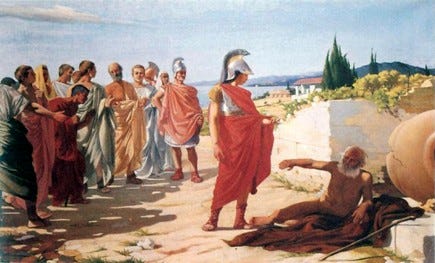
Diogenes lived in a wine jug. When Alexander the Great offered to give him anything he wanted, Diogenes told him to stop blocking his sunlight. Pictured by Paride Pascucci (1891).
There is an inherent tension between the goals of philosophy and the logic of institutions. The point of philosophy is to follow the argument where it leads, even to the bottom of a cup of hemlock. Whatever their stated mission, institutions inevitably adopt institutional survival as a paramount goal. They may reward people who advance the cause for which the institution was established. But, in practice, they will often bestow honor on those who simply promote the smooth functioning of the machine through conformity and risk aversion. People who are by nature disposed to defend the Current Thing can serve as foils for other philosophers. But philosophy as a discipline makes no sense if everyone is like that.
We now have the absurd situation where the limits of philosophical inquiry are set by the most emotionally fragile students at each university. Except for the libertarians, philosophers who publicly challenge conventional left-wing views have been virtually purged from academia.
I recently started a one-year, part-time postdoc at Ghent University. I’m very happy to be here, except when students are throwing bottles at my head because they disagree with my lecture. However, I am hanging on to an academic career by my fingernails. I would ask my critics to think about the day after I am banished for good. Will philosophy really be more interesting or better equipped to address important problems when there is no room for someone like me?
What a disgrace for Cambridge. The hypocrisy, the double standards, and the sheer stupidity (by a KC, no less, which tells you something about the English legal profession) are appalling and would be hilarious, if their result wasn't utterly unfair to you and to scholarship truly understood.
How far, how horribly far, has my once-great alma mater not fallen.
Now we'll see if Ghent has backbone. I hope you have good friends there.
Apart from all other aspects of it, your case seems to be another example of the feminization in the sense of emotionalization of academic disputes described by Helen Andrews. I include the gutless master, Doug Chalmers, in that description. Like many male individuals in contemporary Britain, he seems completely castrated when it comes to defending scholarship, honesty, and free speech.
"Having decided that Jones and Haier have no business commenting on intelligence research, McColgan relied on her own self-perceived expertise, which led her to conclusions such as “over 3 million Black Americans [have] an IQ of over 135” and 0.67 is bigger than 0.7."
Reminds me of the quote from Voltaire: "I have never made but one prayer to God, a very short one: Oh Lord, make my enemies ridiculous. And God granted it."