Don’t Scapegoat Women
Wokism is an idea-driven ideology that predates the Great Feminization by more than a century

According to former American Conservative editor Helen Andrews, wokism is “simply feminine patterns of behavior applied to institutions where women were few in number until recently.” It “appeared out of nowhere” in the 2010s because that’s when female representation at elite institutions passed the 50% mark. Cancel culture—which she sees as a central component of wokism—is “simply what women do whenever there are enough of them in a given organization or field.” Women such as herself may be exceptions, able to live up to male standards. But groups of women inevitably go woke because that is their nature.
Andrews defended this theory at the National Conservatism Conference last September, and her talk is one of the most watched videos on NatCon’s YouTube channel (270,000 views as of today). In October, she published a viral article on the same topic. Many people appear to agree with her own assessment that “the explanatory power of this simple thesis [is] incredible.”
Concern about the Woman Question has been percolating on the right for several years. Noah Carl argues that it is “plausible that the influx of women into academia...contributed to...the rise of woke activism.” Cory Clark and Bo Winegard propose the similarly cautious thesis that “many emerging trends in academia can be attributed, at least in part, to the feminization of academic priorities.” Richard Hanania worries about our inability to stand up to “women’s tears.” Amy Wax complains that women have elevated “the values of the nursery and the kindergarten” over reason, evidence, and objectivity. According to Arnold Kling, “we have made institutions harder for warriors [i.e., people with stereotypical male psychology] to navigate.” Andrews goes further than anyone else, claiming that wokism just is (by definition?) women being women.
Her argument is as follows:
The fact that wokism is female nature applied to institutions explains why “everything you think of as wokeness involves prioritizing the feminine over the masculine: empathy over rationality, safety over risk, cohesion over competition.”
Wokism began when the demographics at previously male-dominated institutions and professions tipped to majority female. In the US, women demographically surpassed men at law schools in 2016, the New York Times staff room in 2018, medical schools in 2019, and law firms in 2023. They became the majority of college-educated workers in 2019, and the majority of college instructors in 2023. “So the timing fits.” As soon as women achieved sufficient representation to impose their “patterns of behavior” on the rest of society, we got wokism.
The feminization of our culture (and therefore wokism) is the result of artificial social engineering. Judges and government bureaucrats force institutions to hire unqualified women, and “anti-discrimination law requires that every workplace be feminized.” If a workplace does not cater to their gender-specific preferences, women can sue and get large payoffs, but men have to suck it up.
The solution to wokism is to repeal anti-discrimination laws.
During the George W. Bush years, Stephen Colbert coined the word “truthiness” to refer to ideas that feel true even if they are not supported by evidence. Andrews’s argument is, I suggest, a case study in truthiness. The idea that women cause wokism seems to jibe with lived experience. If you say something politically incorrect at work or school, you’ll probably be hauled into a woman’s office. (HR departments are 74% female.) Woke academic fields such as English, sociology, and Grievance Studies are estuaries of estrogen. The blue-haired female college student is a classic woke stereotype. But there is a big leap from that, which is true, to Andrews’s conclusion.
On my account, wokism is a coherent ideology. It is what follows from taking the equality thesis seriously, given a background of egalitarian morality. The equality thesis, which says that all groups have the same innate distribution of socially relevant traits, has been a tenet of Western liberalism for more than a century. Virtually everything you think of as wokism is a rational, moral response to persistent inequality of outcome, given the false belief that race is skin deep and the sexes are interchangeable. Over the course of the 20th and early 21st centuries, wokesters made increasingly desperate attempts to fix the environment and bring about equality of outcome among groups. But, to the extent that race and sex disparities reflect natural differences that cannot be fixed, the woke project failed. Wokesters were forced to resort to magical thinking about microaggressions and systemic racism to explain why the gaps won’t go away.
I will address each of the four steps of Andrews’s argument in turn. They are all wrong, except for step (3), which is half wrong.
As women gain cultural influence, norms inevitably change to reflect their preferences. Whether female dominance in our institutions is a “threat to civilization,” as Andrews claims, is a question that I will leave aside. But the Great Feminization did not precipitate wokism or cancel culture. Feminization and wokism are separate issues.
Woke = Women?
According to Andrews, women are biologically adapted to ostracize (i.e., cancel) rivals and defend group cohesion at all costs. Thus, putting women in charge will inevitably lead to cancel culture and the privileging of inclusion over free speech—what she considers the hallmarks of wokism.
In fact, cancel culture is the normal condition of human society, not something specifically woke or female. Due to greater risk aversion, women are on average less supportive of free speech, but they are more likely than men to be against all controversial speech, including woke speech.
Cancel Culture Cattiness
Andrews declares that “all cancellations are feminine....Cancel culture is simply what women do whenever there are enough of them in a given organization or field.” The implication is that men—or at least masculine men—don’t cancel each other. She says that “one of the first times that a cancellation happened” was the Larry Summers affair in 2005. A female-led mob attacked Summers for speculating that women may be underrepresented at the highest levels of mathematical talent. He was ultimately forced to resign from the presidency of Harvard. For Andrews, cancel culture became a society-wide problem in the 2010s because that’s when women achieved >50% representation in various institutions and professions.
This argument does not hold up to even a moment of critical thinking. Every moral/political system that has ever existed has had red lines for thought, speech, and action. What people are cancelled for and the ferocity of moral vengeance differ across time and place, but not the fact that there are cancellable offenses. In terms of the range of allowable opinions and the toleration of dissent, our feminized culture is, by historical standards, exceptionally free.
Since 2019, Harvard has required job applicants to submit loyalty oaths to wokism. (These “diversity statements” were recently rebranded as “service statements,” which are effectively the same thing.) There are virtually—possibly literally—zero conservatives at the assistant professor level. Does that mean Harvard was committed to impartial truth and justice before it became overrun by women with a biological urge to spread cancel culture?
Let’s see what Harvard looked like before the “Great Feminization” of the 2010s—or, even better, before women participated in public life at all.
According to the “Laws of Harvard College” in 1767, people who violate moral norms must be publicly shamed. (Public shaming existed before social media.) If a Scholar does not “carefully apply himself to the Duties of Religion” on the Sabbath and does not reform after private admonition,
he shall receive a public Admonition, or be punished by Degradation or Rustication.
A man can literally be guilty by association. If you’re too friendly with a cancelled person, you yourself will be cancelled:
If any Scholar shall associate with any Person of an ill Character, or with one that is rusticated or expelled, within three Years after such Expulsion or Rustication, unless the rusticated Person shall be restored within that Space, he shall be fined not exceeding five shillings, for the first Offence; And if any Undergraduate shall persist therein, he shall be further liable to Admonition, Degradation, or Rustication, according to the Circumstances of the Offence.
So-called “atrocious crime[s]” that can result in expulsion include triggering people with language that challenges their religious beliefs (“blasphemy”):
If any Scholar shall be convicted of Blasphemy, Fornication, Robbery, Forgery, or of any other atrocious Crime, he shall be rusticated or expelled, as the Nature and Aggravation of the Offence may require.
A student can be denied his degree on the basis of morally objectionable behavior, which includes disagreeing about religion:
If any Bachelor of Arts, whether residing at the College or not, shall be guilty of any heinous Insult towards any in the Government of the College, or any scandalous Immorality, he shall be accountable therefor, whenever he comes to ask for his second Degree.
You can’t be admitted to Harvard College in the first place unless you are sufficiently morally pure (“of an unblemished life”), meaning you subscribe to the institution’s special brand of New England Protestantism:
Every Scholar who is able to translate the Original of the Old & New Testament into the Latin Tongue, & has a good Acquaintance with the Classics, is well instructed in the Principles of the Mathematics, of natural & moral Philosophy, of Logic & Rhetoric, & is of an unblemished Life; & at a public Exercise shall have the Approbation of the President & Fellows, with the Consent of the Overseers, may be admitted to a first Degree viz. Bachelor of Arts.
Every element of cancel culture was written into the 1767 “Laws of Harvard College” so shamelessly even Claudine Gay would be embarrassed to plagiarize it.
The history of religion, politics, and academia is largely the story of men cancelling each other. In traditional Judaism, Christianity, and Islam, disagreeing with the catechism often meant excommunication or execution. The liberal French Revolution culminated in the guillotining of “counter-revolutionaries” who had slightly dissident interpretations of “liberty, equality, and fraternity.” The communist experiments of the 20th century ended with people mass reporting each other for thought crimes. More than 100 years before I was expelled from Emmanuel College at the University of Cambridge for challenging DEI, Bertrand Russell was subject to an even more vicious cancellation campaign and fired from Trinity College for advocating pacifism during WWI. All of this and much more was done entirely or primarily by men.
In the US, racism has been one of the main reasons people are cancelled since the 1960s. In 1999, Donald Trump tried to take down his rival for the Reform Party presidential nomination Pat Buchanan by calling him a “Hitler lover” and an “anti-Semite.” “He doesn’t like the blacks, he doesn’t like the gays,” said Trump. This sort of talk (justified or not) was common decades before the Great Feminization.
Again, Andrews says that “all cancellations are feminine.” But what was feminine about everything I just described? If she has an answer to this question, she doesn’t say what it is.
As institutions become more female, the targets and methods of cancellation may change to reflect female preferences and dispositions. For example, women are more likely than men to consider “unwanted advances” (i.e., a man pursuing a woman who doesn’t find him attractive) to be a heinous crime that deserves to be punished. Women but not men can get people fired by pointing and crying. MIT biology professor Nancy Hopkins said that she had to leave Larry Summers’s talk because otherwise she would have “either blacked out or thrown up”—something a man wouldn’t have done. But cancellation per se is not specifically feminine. And there’s no evidence that women are inherently more prone than men to want to cancel people for woke reasons.
Women vs. Free Speech
Andrews claims that women favor cohesion over free speech. The only empirical evidence she cites to support this is a 2019 Knight Foundation survey in which 71% of college men vs. 41% of college women said that “protecting free speech” is more important than “promoting an inclusive society.” Incidentally, this survey failed to replicate in a follow-up by the Knight Foundation and Ipsos in 2022. The 2022 study found that “female students are more likely than male students to say that free speech rights are extremely important.” But most survey data suggest that women are in fact less committed to civil liberties than men.
Andrews cites Clark and Winegard, who mention a 2017 YouGov survey of current or former American college students. Subjects were given a list of 13 hypothetical speakers with controversial views, and asked who should be allowed on campus. A majority of men supported the free speech rights of 12/13 speakers (every speaker except one who “advocates violent protests”). A majority of women were opposed to the free speech of 13/13 speakers (including one case where 50% of women said the speaker should not be allowed to talk vs. 48% who said he should be).
So there you have it, women are genetically programmed to be woke. Case closed, right?
Actually, the data point to a different conclusion: women are less supportive of free speech for both right- and left-wing views. A solid majority of women (60%) want to ban a right-wing speaker who says that “police are justified stopping African Americans at higher rates” or “whites and Asians have higher IQ.” But almost the same percentage of women (61%) want to ban a woke speaker who “criticizes the police” or says that “all white people are racist.” In other words, the majority of women don’t want to defend or criticize the police. The majority don’t want to hear that whites and Asians have a higher IQ (a non-conspiratorial explanation for white and Asian overrepresentation vis-à-vis blacks) or that all whites are implicated in racism (a woke idea).
A 2025 survey by the Foundation for Individual Rights and Expression (FIRE) got similar results. When presented with a list of controversial speakers, college men were over 3.5 times more likely than women to advocate free speech for all. Men often supported the free speech of their political opponents more than women supported the free speech of their allies.
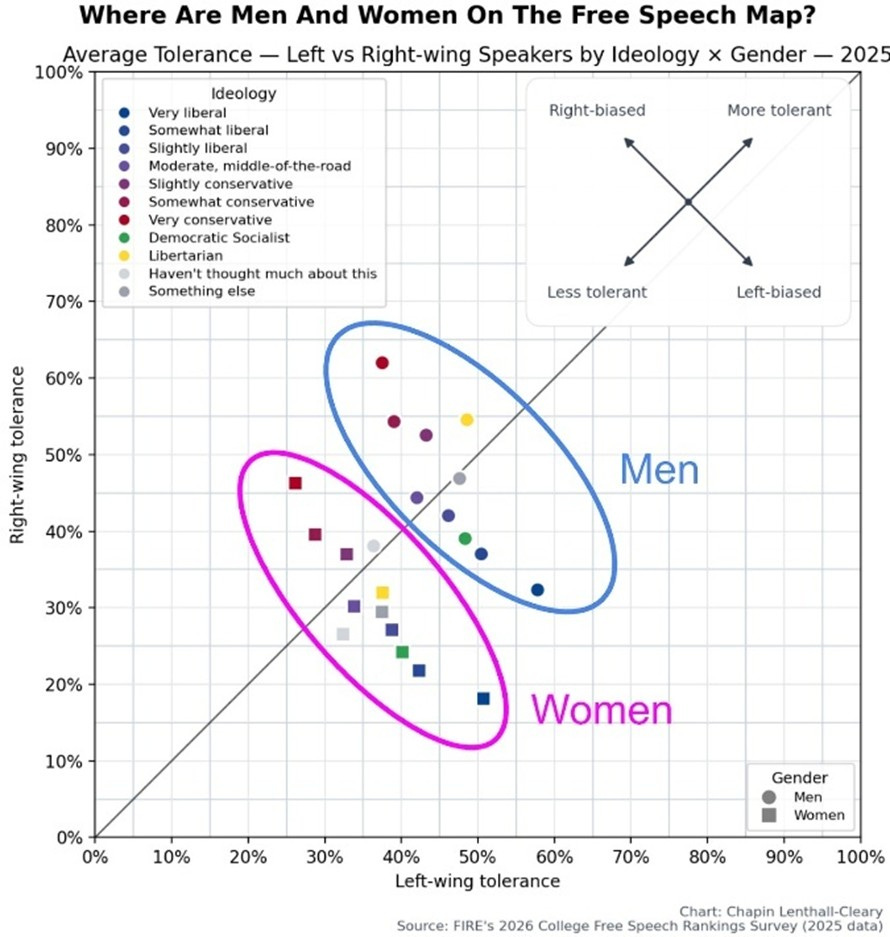
Men support free speech for their enemies as much as women do for their friends. From FIRE.
Consider Cory Clark’s observation that “Women are more supportive of illegalizing insults of immigrants, homosexual individuals, transgender individuals, the police, African Americans, Hispanics, Muslims, Jewish people, and Christians, and are more supportive of banning sexually explicit public statements and flag burning.” Once again, this is not wokism. Woke logic inexorably leads to the conclusion that the police are bad (they disproportionately target members of certain groups) and America is a racist country (because of racial disparities). From a woke perspective, Christianity is potentially suspect because it is associated with Europe and white people. But women are more likely than men to want to criminalize insults against the police, flag, or religion of the oppressors.
One of the most profound sex differences is in the desire for safety. A woman can have at most a dozen or so children in her life, whereas a man can have hundreds. From an evolutionary perspective, it pays for men to take big risks for power, status, and resources that might result in a fitness boon. Women are better off playing it safe to protect the small number of children they have or may have in the future. Therefore, men evolved a taste for danger that is alien to most women. This is why 89% of Darwin Award winners (people who remove themselves from the gene pool through reckless behavior) are men. It is also probably part of the reason why men are more likely to welcome intellectual combat, and not feel as threatened by speakers with controversial views.
The best way to discover truth is usually to have a debate between advocates of different ideas. It is a problem that the majority of women want to shut this down. However, that does not make women inherently woke. Most women want to be protected from controversy coming from both the woke left and anti-woke right. Their lodestar is safety, not race communism per se.
Wokism Is More than 100 Years Old
The linchpin of Andrews’s argument is timing. Wokism “appeared out of nowhere” when female representation reached a tipping point around the Great Awokening, ergo the latter caused the former.
In fact, what we now call “wokism” has been the ideology of Western liberals for more than a century. Women were mass recruited into institutions largely because the white male elites were already woke. For reasons I explain below, the influx of women may have reinforced trends that already existed, but causality was primarily woke → women, not women → woke.
As I discuss elsewhere, John Locke, the “Father of Liberalism,” first defended the equality thesis in 1690. He claimed that if an Englishman had been raised as a Hottentot in Africa, he would be no different from an African. If a Native American were educated in England, he would be “as good a mathematician as any in it.” For whatever reason, Locke didn’t seriously think through the moral implications of racial blank slatism, so he himself never became woke. But the ingredients of wokism were there in 1690.
Many liberal luminaries such as John Stuart Mill, Alfred Russel Wallace, and Alexander von Humboldt believed the same thing as Locke. By the late 19th century, race denial was arguably the orthodoxy among Western liberals. It became a foundational principle of behaviorism—an influential movement in psychology founded by John B. Watson in the early 20th century.
When you combine the equality thesis with Christian moral sensibilities (“There is neither Jew nor Greek, there is neither slave nor free, there is neither male nor female” and “inasmuch as you did it to one of the least of these My brethren, you did it to Me”) you get wokism.
Wokism in the United States reached its first crescendo in the 1860s when the Union Army permanently cancelled 258,000 white Confederate soldiers in order to free the black slaves. The goal of ending slavery in America was a noble one. Defenders of the system claimed that all Africans—and only Africans—are by nature suited to slavery, which was empirically false. However, many abolitionists in America and Europe argued that, beneath the skin, Africans are on average biologically the same as Europeans, and that under just conditions there would be equality of outcome. Prominent abolitionist race deniers included Charles Sumner (US Senator), Thomas Clarkson (Cofounder of the Society for Effecting the Abolition of the Slave Trade in Britain), and Henri Grégoire (French revolutionary leader and Catholic priest).
The original goal of the Civil Rights movement was legal equality. With the Civil Rights Act of 1964 and the Voting Rights Act of 1965, this was a fait accompli. People almost immediately realized, however, that legal equality would not bring about equal results. The next frontier of civil rights was affirmative action. That, too, had limited success. Believers in the equality thesis began a futile hunt for the mysterious forces that were holding back certain historically persecuted groups, particularly blacks.
The tipping point for the Great Awokening wasn’t female representation passing 50%. It was when people realized that another generation of affirmative action and Black History Months were not going to bring about equality of outcome. Perhaps catalyzed by social media, the moral panic began around 2012. People started using the word “woke” to describe what was happening, but the ideology came long before the word. Previously it was called “political correctness,” and before that it went by other names.
The empirical premise of wokism is that all groups—including the sexes—are innately the same, at least with respect to socially relevant psychological traits. Therefore, in a just world men and women would have equal outcomes.
As it turns out, men and women are roughly equal in terms of average general intelligence. However, men have slightly greater variance (they are overrepresented at the very high and very low ends). The sexes also have different styles of cognition. On average, men are more interested in analyzing and constructing rule-based systems. Women are more comfortable in the realm of feelings. Men gravitate to fields that involve systemization (e.g., computer programming), whereas women are drawn to people-facing professions where they can express empathy (e.g., nursing, HR). On average, men are also more fiercely ambitious and less concerned with work/life balance.
Once upon a time, women were discriminated against and most disparities between men and women could be attributed to sexism. The Civil Rights Act of 1964 banned discrimination based on race and sex. Within a few years, this was interpreted to mean that there is a de facto obligation to discriminate in favor of underrepresented groups, including women.
Many women do not require affirmative action to succeed at a high level. However, in the absence of intervention, fields such as math, engineering, philosophy, and finance will skew heavily male due to differences in cognition and ambition.
In the past several years, elite institutions have doubled down on affirmative action to bring female representation up to a level that wokesters find acceptable. To meet de facto quotas, employers have had to reach deeper into the pool of less qualified female candidates. For obvious reasons, affirmative action hires often have a chip on their shoulder. Many of them turn to social justice activism to distract from the fact that they aren’t as good at their job as the straight white men who earned their position based on merit, or weren’t hired at all. But we wouldn’t have this level of affirmative action for women in the first place unless the (mostly male) elites had already been woke.
The Great Feminization may also have reinforced wokism because female influence will reinforce any orthodoxy. Women seek safety in what is culturally familiar, which, in our society, is social justice and race denial. In other times and places, women have been equally enthusiastic about protecting non-woke orthodoxies. They are naturally conservative, not woke.
Thou Must Be Feminine
Andrews blames the Great Feminization on anti-discrimination laws that force institutions to hire women and potentially create workplaces that feel “like a Montessori kindergarten.”
The Damoclean sword of civil rights law has been hanging over our heads since the 1960s. However, as I explain elsewhere, contemporary civil rights law is a consequence, not the cause, of wokism. Civil rights laws were originally intended to apply to everyone equally, but judges and bureaucrats interpreted them as demanding special treatment for women and minorities. The law did not make people woke. It was because the elites were already woke that they made and enforced woke interpretations of the law.
The moral panic that began in the 2010s led institutions to adopt even more draconian measures to achieve diversity. As Jacob Savage has documented, ten years ago elite institutions were (and to a large extent still are) run by boomer and gen X white men. These senior white men decided to achieve diversity by blackballing the next generation of white males from junior positions. To take a representative example from Savage, Yale’s history department currently has 10 white male professors in their 70s or 80s. But among 16 tenured or tenure-track millennials, only one is a white man. At the New York Times Magazine, the editor-in-chief and editorial director are both gen X white men. But out of nine millennial senior editors and story editors, only one is a white man, and he was hired in 2012—right before DEI went off the rails.
No one made a law in 2014 that said only 1/16 young professors at Yale can be a white man. In fact, from a legal perspective, there was no real difference between the 2010s and the 1990s or even the 1970s. The culture was evolving organically according to woke logic. After two to three generations of affirmative action failed to bring about equality of results, it was time to take it up a notch. Boomer and gen X white men glutted the institutions with women and minorities in large part because they were committed to taking the equality thesis seriously.
Beating Woke
Andrews’s proposed solution is to repeal civil rights laws and thereby purge the institutions of their excess women. In her view, because women are the problem, when their influence is sufficiently reduced, wokism will go away.
This gets everything backwards. Women are more averse to controversy, but not innately woke. Race communism has been the ideology of liberal elites (male and female) for at least a century, long before the Great Feminization.
The solution to wokism is simple: refute the empirical premise that generates it. Show that the equality thesis is wrong, and wokism will be impossible. I am aware of objections to this strategy, but have made the case that a Hereditarian Revolution is feasible and desirable.
It is ironic that Helen Andrews was the one to popularize the theory that women cause wokism because they don’t care enough about the truth, and that she did so at the National Conservatism Conference. As editor of the American Conservative, Andrews was one of the chief gatekeepers preventing people like me from telling the truth about race on mainstream conservative platforms. Yoram Hazony—the Pope of National Conservatism—explicitly says that he doesn’t want to hear the truth about controversial topics. For example, in 2020, I published a paper advocating for free inquiry into all causes of race differences in intelligence, including genes. When wokesters started a petition to get the paper retracted, Hazony tweeted the following:
You can’t get to viewpoint diversity in academia by defending the “study of race differences in intelligence.” Such studies are potentially interesting to political racialists and white identitarians. But most conservatives don’t see much value in them.
Later the same day, Hazony referred to “defending race science and Nazi philosophers” and said that “none of that is conservative.” Isn’t this exactly the behavior that Andrews says is feminine, i.e., backbiting and ostracism to suppress controversial facts that threaten group cohesion? It is doubly ironic that Andrews and her fellow National Conservatives believe in cancel culture specifically for people who express the one idea that has the power to defeat wokism, which is hereditarianism.
Enlightenment Liberals vs. the Medieval Peasant Right
The theory that women caused wokism is rooted in a profoundly mistaken view about the role of ideas in politics. (By “ideas” I mean claims that meet some minimum standard of rationality. Candace Owens’s declaration that the moon landing was “fake and gay,” for example, is not an idea in this honorific sense.)
The stupidification of the Republican Party began in earnest under George W. Bush. Before that time, college graduates in America leaned slightly Republican. After 25 years of alienating smart people, we have now reached the point where it is common for prominent conservatives to invoke literal demons as an explanation for social phenomena. Even Andrews’s former colleague at the American Conservative, Rod Dreher, seriously believes that Tucker Carlson was scratched by a demon while he slept in a bed with four dogs. In 2024 I tweeted that many American conservatives have the same worldview as medieval peasants and that, left to themselves, there is a chance that they might start burning witches. I was inundated with replies saying that medieval peasants were right and of course we should execute witches. Conservative discourse revolves around celebrities, interpersonal beefs, conspiracy theories, imaginary grievances, science denial, and proclamations of loyalty to Donald Trump.
For people who have been marinating in the online right for the past decade, it is easy to forget that a large and influential segment of the left is not like this. Liberal elites have a good track record of responding to facts and logic on many issues including evolution, religion, and economics. In regard to wokism, it is liberals, not mainstream conservatives, who display intellectual consistency. Both the mainstream left and right claim to believe in the equality thesis, but only the leftists are smart and moral enough to recognize that wokism follows from that.
MAGA conservatives think they can defeat the left through the exercise of naked power, with no attempt to win over ideologues on the other side. They will not be successful. Intelligent, morally sensitive people remain overwhelmingly woke Democrats who are increasingly disgusted by the freakshow that is the American right. Trump’s third-worldist style of government will make life worse for the majority of people not directly participating in his many grifts. Sooner or later, Democrats are going to retake the White House and seize the dictatorial powers that Trump has created for the president. Whatever the right has gained by thuggery will disappear in an instant.
Permanent victory will only be achieved when a critical mass of cognitive elites accepts that the equality thesis is false, thereby making wokism impossible. Scapegoating women provides conservatives with yet another excuse to shirk from the battlefield of ideas where the fate of this ideology will be decided.
Great analysis. May I humbly add the following nuance that I may be in a unique position to add, in support of your argument ( and challenging Andrews further). The Soviet Union , famously, liberated women and brought them into employment en masse resulting in demographic feminisation of certain professions previously considered masculine ( without , I must add, taking away the prestige associated with those professions). Example? Medicine. Not nursing. Medicine. It became dominated by women, with female/male ratios being 60: 40 , perhaps even 70:30 in places. That did not result in wokism or anything of this kind.
As an aside, but an important one, the Soviet Union never developed a notion of innate equality with respect to abilities. Rather it insisted on equality of opportunity and severed the strong correlation between ability and reward (a sort of non- meritocratic culture). A popular expression that summarised it was the famous: ' From everyone- according to their ability, to everyone- according to their need'.
Excellent piece. It speaks to several of my frustrations with the discourse on the Right in recent years. The Right is still much closer to the truth on these issues than the mainstream, but there's still much room for improvement.
On wokeism not being new, I think there can be a tendency in our spaces to assume that wokeism, or liberalism, or leftism sprung up of the ground at a specific point: 1945, or the 1960s, or the 2010s, depending on who you ask for "when things went wrong". There's a deeper issue we need to seriously grapple with: liberalism (in a broad sense) is what's brought us the material prosperity and freedom of the modern world, but its egalitarian and atomising impulses seem to contain the seeds of its own demise.
I'd even go further back than the early liberal philosophers starting in the 1600s, proto-leftism has happened before. You can find echoes of leftist ideas and values in classical texts from the periods of Greece and Rome's declines. Even further back, it seems to be the case that most ancestral human societies were envious of the successful and engaged in egalitarian levelling (Jeremy Kaufmann on X has discussed this before). Respect for excellence seems to be a rarity among human societies, and in the West we may currently be reverting to the human norm.